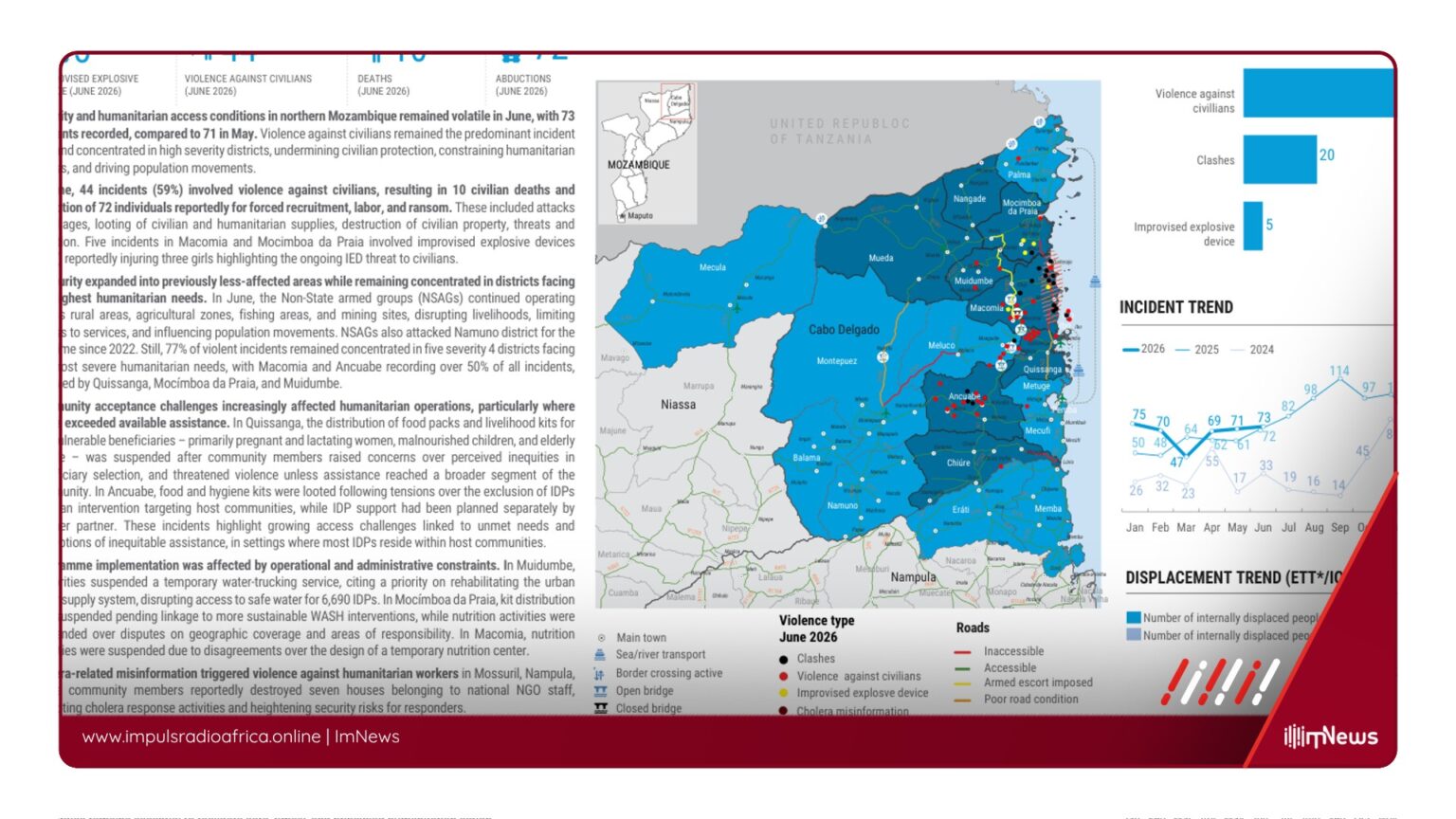
Mozambique’s Northern Provinces Face Heightened Humanitarian Access Challenges in June 2026 BODY: Cabo Delgado, Mozambique – The UN Office for the Coordination of Humanitarian Affairs reports that security and humanitarian access conditions in Mozambique’s northern provinces, particularly Cabo Delgado, Niassa, and Nampula, remained volatile in June 2026.
A total of 73 incidents were recorded, with violence against civilians being the predominant incident type, particularly in high severity districts.
In June, 44 incidents, or 59% of the total, involved violence against civilians, resulting in 10 civilian deaths and the abduction of 72 individuals. This included attacks on villages, looting of civilian and humanitarian supplies, destruction of civilian property, threats, and extortion.
In Macomia and Mocimboa da Praia, improvised explosive devices (IEDs) were used, injuring three girls and highlighting the ongoing threat to civilians.
The insecurity expanded into previously less — affected areas, with non-State armed groups (NSAGs) operating across rural areas, agricultural zones, fishing areas, and mining sites.
The districts facing the most severe humanitarian needs, including Macomia and Ancuabe, recorded over 50% of all incidents. Community acceptance challenges increasingly affected humanitarian operations, particularly in areas where needs exceeded available assistance.
In Quissanga, food and livelihood kits distribution was suspended following community concerns over perceived inequities in beneficiary selection.
In Ancuabe, food and hygiene kits were looted due to tensions over the exclusion of internally displaced persons (IDPs) from an intervention targeting host communities. Programme implementation was also affected by operational and administrative constraints.
In Muidumbe, a temporary water — trucking service was suspended to prioritize urban water supply system rehabilitation.
In Mocímboa da Praia, kit distribution was suspended pending linkage to more sustainable water, sanitation, and hygiene (WASH) interventions. Nutrition activities were suspended in Macomia over disagreements on the design of a temporary nutrition center. Cholera-related misinformation triggered violence against humanitarian workers in Mossuril, Nampula, where community members destroyed houses belonging to national NGO staff, disrupting cholera response activities and increasing security risks.
Logistical constraints further affected physical access, with UNHAS flights to Ibo district suspended due to poor airstrip conditions. Overall, humanitarian access in June continued to be constrained by insecurity, community acceptance issues, logistical limitations, and administrative barriers. Sustained engagement with communities and authorities is essential to facilitate safe, timely, and principled humanitarian action.
*Additional reporting by ImNews | Sources consulted: 2*
—
This original article was produced by the ImNews editorial team
Source: reliefweb
Source: UN Office for the Coordination of Humanitarian Affairs