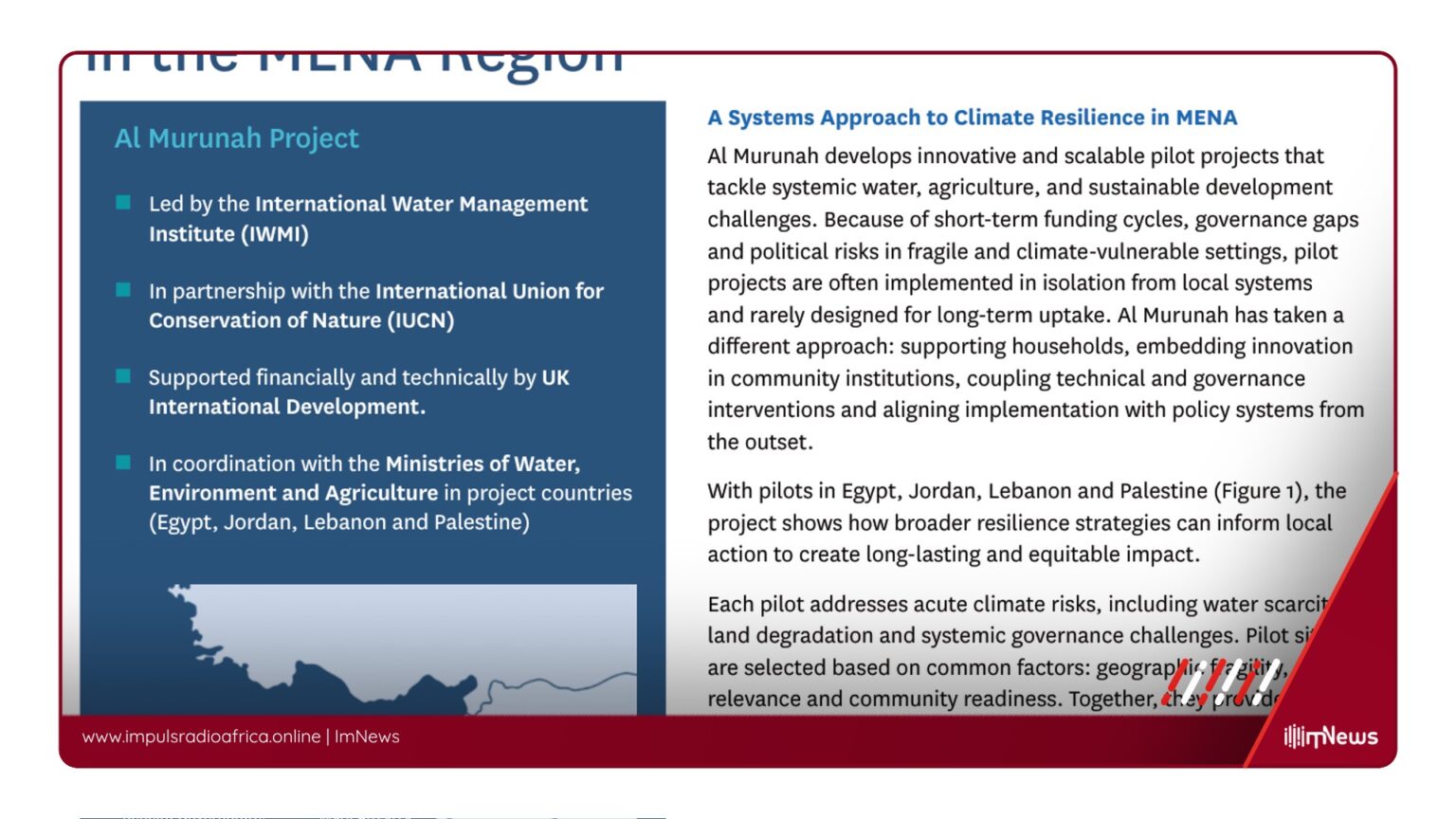
CAIRO, Egypt — The Al Murunah project, a pioneering initiative in the Middle East and North Africa (MENA) region, is fortifying climate resilience and water security through innovative, nature-based water solutions. Implemented by the International Water Management Institute (IWMI) in partnership with IUCN, this five-year project, supported by the UK Government, is a beacon of hope amidst the region’s severe water scarcity and climate change impacts.
The project zeroes in on Egypt, Jordan, Lebanon, and Palestine, nations addressing the dual pressures of escalating water demand and the degradation of water resources. Al Murunah’s thematic brief outlines the deployment of scalable, resilient nature-based water solutions (RNBWS) pilot projects, which blend technical ingenuity with inclusive governance and community-led strategies to combat water scarcity and land degradation.
In Egypt, the pilot sites are meticulously designed to bolster water security, intertwining technical interventions with community empowerment, with a particular focus on women and youth. This multifaceted approach not only aims to enhance water accessibility but also to cultivate sustainable practices that contribute to the region’s long-term resilience.
The MENA region, the most water — scarce globally, relies heavily on water for agriculture, accounting for over 65% of total water use. This reliance has placed immense pressure on aquifers, rivers, and reservoirs, deepening the water crisis.
The Al Murunah project represents a paradigm shift in water management, embedding integrated and scalable interventions within local institutions, households, and policy systems. Its goal is to establish a sustainable model capable of replication across the region.
The thematic brief emphasizes the pivotal role of these pilot projects in reinforcing climate resilience and water security across the MENA region. It underscores the necessity of a comprehensive approach that intertwines technical innovation with community engagement and policy reform.
As the project advances, it is anticipated to provide valuable insights into the integration of nature — based solutions into water management practices.
The outcomes of these pilot projects hold the potential to influence similar initiatives worldwide.
The Al Murunah project exemplifies the transformative power of collaboration and innovation in addressing critical global challenges. It highlights the significance of a Pan-African strategy in tackling issues that transcend national borders, such as climate change and water scarcity.
As the project unfolds, it will be closely monitored by stakeholders across the region and beyond. Its success could herald a new era of sustainable water management and climate resilience in the MENA region.
In conclusion, the Al Murunah project is more than a project; it is a vision for a sustainable and resilient future for the Middle East and North Africa. Its impact will resonate not only in the areas where it is implemented but also in the broader context of global water security and climate change adaptation.
*Additional reporting by ImNews | Sources consulted: 5*
—
This original article was produced by the ImNews editorial team
Source: reliefweb
Source: International Water Management Institute