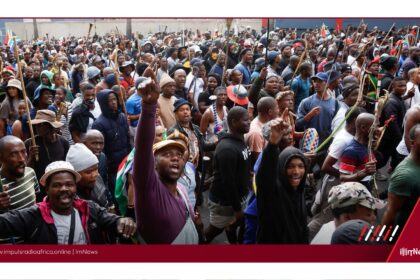
Durban’s Xenophobia Erupts: Migrants Fleeing Amidst Protests and Violence BODY: Durban, South Africa – A surge of anti-foreigner sentiment has gripped Durban, as over 2,000 protesters, many brandishing sticks and clubs, took to the streets. This wave of violence and protest follows weeks of campaigns against undocumented immigrants, resulting in at least four deaths and a mass exodus of foreign nationals from the region.
In the coastal city, which has been on edge, the streets remained unusually quiet with shops shuttered, as tension hung heavy in the air. Protesters, dressed in Zulu attire, chanted “Abahambe! ” (They must go!
in isiZulu), their rallying cry reflecting the movement’s intent. Campaign groups have set an arbitrary deadline of 30 June for undocumented immigrants to leave the country. Many are fleeing their homes in fear, sleeping rough on pavements, in open fields, and in makeshift camps, hoping for repatriation to their home countries.
Several African governments have arranged buses or planes to bring their citizens home, with police reporting over 25,000 repatriated so far. Jackson Makungwa, a 29-year-old Malawian national, had once seen South Africa as a “country of hope. “.
However, he faced the harsh reality of being unable to renew his work permit for the past two years. His friend’s attack and the threat of violence if he remained in the country changed his mind. “They said the deadline is the 30th, so they will attack me if I stay, “he explained, showing a photo of his son, born to a South African mother, left behind in South Africa.
In Pietermaritzburg, 50 miles from Durban, a 29-year-old Malawian national was killed by a mob after a protest on 19 June. Families have camped outside an abandoned building, awaiting repatriation. Lydia Mpingashato, a Zimbabwean cleaner, was informed of her dismissal and threatened. “.
Now I have no plan; I’m just going home to be safe, “she. Many South Africans blame immigrants from elsewhere on the continent for the country’s high unemployment rate and crime levels. “Xenophobia and Afrophobia … emerge where economic insecurity, high unemployment, inequality, weak governance, and poor migration management intersect, “says Philile Ntuli from the South African Human Rights Commission.
The government has sought to ease public anger by intensifying its crackdown on undocumented immigration, arresting over 50,000 undocumented migrants since January. President Cyril Ramaphosa met with protest leaders and warned against “vigilantism “as the marches began across the country, with a heavy security deployment visible.
As the violence continues, the future for foreign nationals living in South Africa remains uncertain. Many are leaving the country in fear, while others brace for the possibility of further violence.
*Additional reporting by ImNews | Sources consulted: 5*
—
This original article was produced by the ImNews editorial team
Source: The guardian
Source: Julie Bourdin in Durban