BANGUI, Central African Republic — Amidst ongoing conflict and displacement, the Central African Republic is facing a severe food insecurity crisis, with an estimated 2 million people, nearly 30 percent of the analyzed population, predicted to be acutely food insecure between April and August 2026.
The country’s agricultural production has been constrained by conflicts and displacements, limiting farmers’access to essential inputs and crop-growing areas.
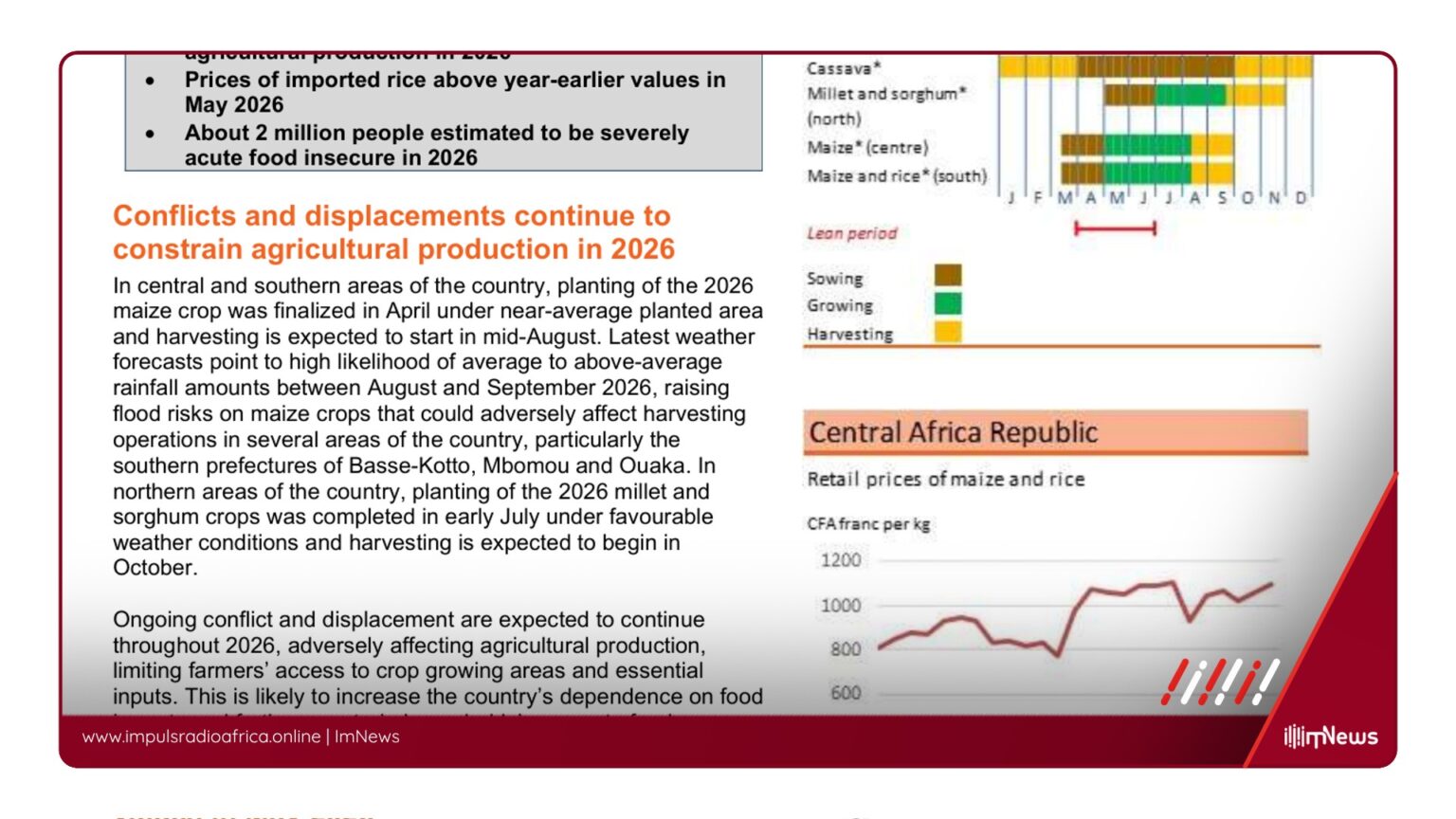
In central and southern regions, the planting of the 2026 maize crop was completed in April under near-average conditions, with harvesting expected to commence in mid-August.
However, weather forecasts indicate a high likelihood of average to above — average rainfall between August and September, which could lead to flooding, adversely affecting harvesting operations in several areas, particularly in the southern prefectures of Basse-Kotto, Mbomou, and Ouaka.
In the northern areas, the planting of millet and sorghum crops was completed in early July under favorable weather conditions, with harvesting expected to begin in October. Despite this, the ongoing conflict and displacement are expected to continue throughout 2026, further constraining agricultural production and increasing the country’s reliance on food imports. Retail prices of imported rice have increased by about 13 percent since January 2026, mainly due to reduced import flows through river trade corridors from the Democratic Republic of the Congo and the Republic of the Congo.
Conversely, the retail prices of locally produced maize have decreased by up to 8 percent year-on-year, reflecting adequate local market supplies.
The United Nations High Commissioner for Refugees (UNHCR) reported that as of March 2026, approximately 428,000 people were internally displaced in southeastern, northeastern, and northwestern parts of the country due to armed violence and civil unrest. This displacement has limited access to markets and livelihoods, exacerbating the food security situation for affected households.
According to the latest Integrated Food Security Phase Classification (IPC) analysis, published in June 2026, about 262,000 people are classified in IPC Phase 4 (Emergency), with conflict, insecurity, and limited agricultural production identified as the primary drivers of food insecurity.
*Additional reporting by ImNews | Sources consulted: 5*
—
This original article was produced by the ImNews editorial team
Source: reliefweb
Source: Food and Agriculture Organization of the United Nations