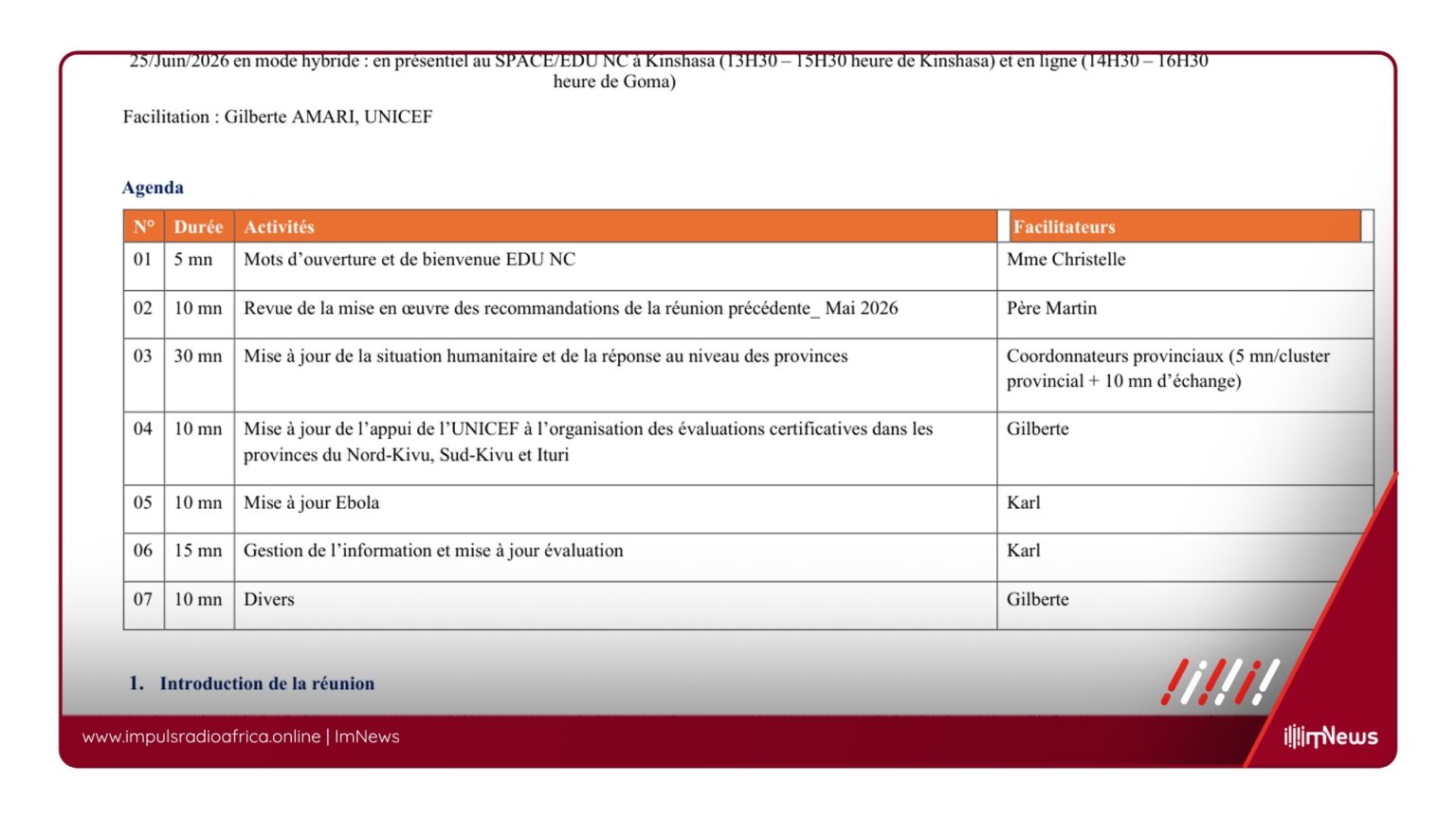
DR Congo: Education Cluster Meets Amidst Challenges and Priorities BODY: Kinshasa, DRC – The Democratic Republic of Congo’s Education Cluster held its monthly meeting in June 2026, focusing on critical discussions amidst the country’s ongoing challenges.
The meeting, which took place against the backdrop of political instability and economic difficulties, highlighted the government’s priorities in the education sector.
The 18th June 2026 Council of Ministers meeting discussed two decrees for the Ministry of Higher Education and a decree for the Ministry of Mines and Geology.
This suggests that the government is focusing on both education and the mining sector, two areas crucial for the country’s development.
However, the monthly meeting of the Education Cluster for February 2026 did not have a verified source to publish its report, suggesting that there might be difficulties in documentation or accessibility. This could be a concern for the transparency and efficiency of the cluster’s operations.
The meeting of the Education Cluster in September 2025 took place in a hybrid format, with some participants attending in person at the UNESCO office and others joining online. This indicates a move towards flexibility and inclusivity in the cluster’s operations, especially in light of the country’s challenging infrastructure and connectivity issues.
The Council of Ministers’meeting focused on decrees for higher education and the mining sector, indicating the government’s priorities at the time.
The decrees for higher education could signal an emphasis on improving the quality and accessibility of higher education in the country, which is crucial for economic development and social mobility.
The Education Cluster meetings suggest an emphasis on collaboration among various stakeholders for educational development.
However, the lack of published reports for some meetings implies potential gaps in information sharing and transparency.
The June 2026 meeting, like those in previous months, likely addressed challenges in the education sector, including access to quality education in conflict-affected areas, teacher training, and the need for infrastructure development.
The cluster’s efforts to bridge these gaps and promote educational reforms are essential for the country’s long-term development.
In conclusion, the Education Cluster’s monthly meetings are a testament to the government’s commitment to addressing the country’s education challenges.
The discussions and decisions made during these meetings are crucial for the development of the education sector and, by extension, the overall development of the Democratic Republic of Congo.
*Additional reporting by ImNews | Sources consulted: 5*
—
This original article was produced by the ImNews editorial team
Source: reliefweb
Source: Education Cluster