

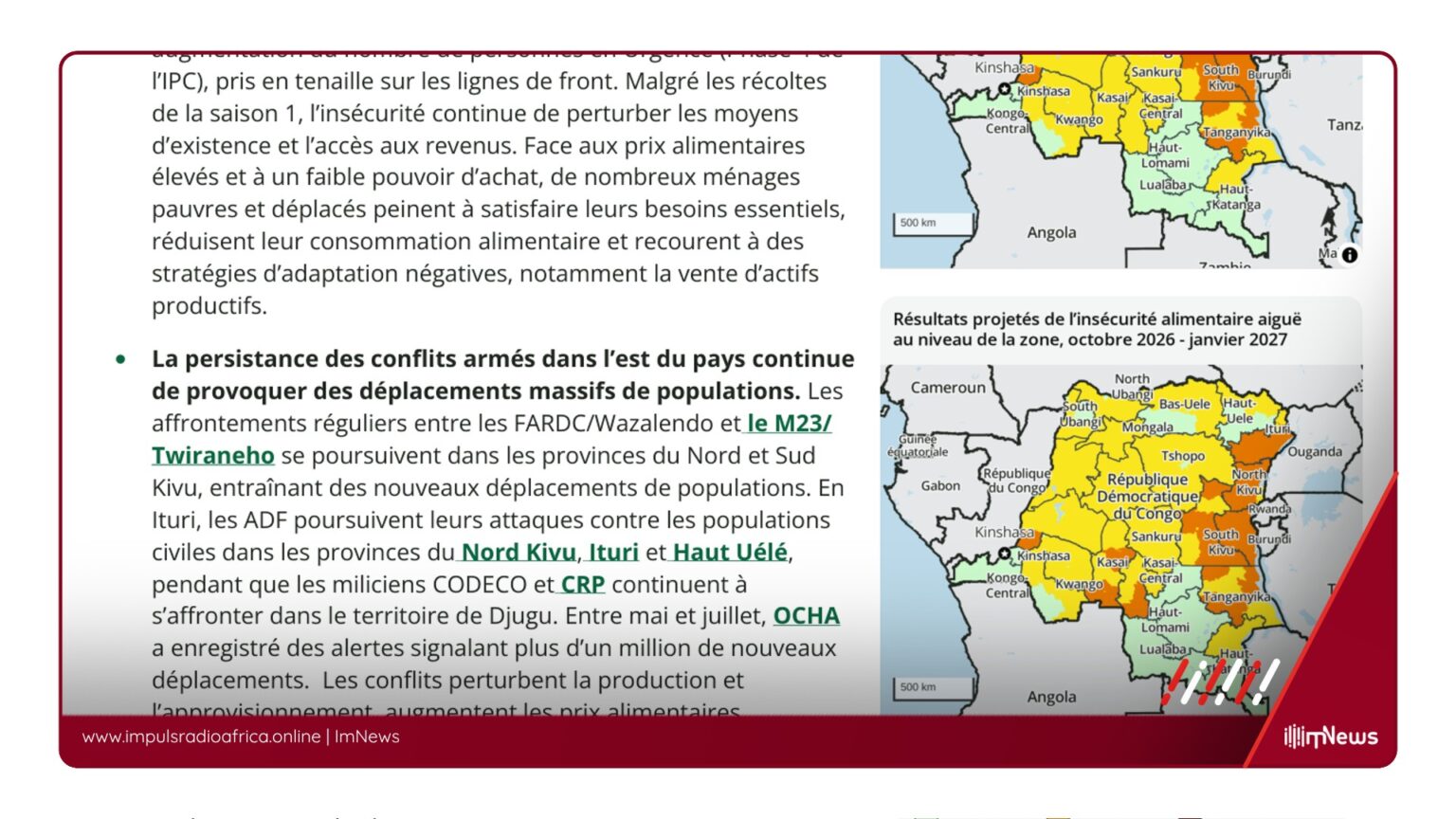
Kinshasa, DRC — The Democratic Republic of Congo (DRC) is addressing a severe food insecurity crisis in its eastern regions, particularly in Nord-Kivu, Sud-Kivu, Ituri, and Tanganyika.
The Famine Early Warning System Network (FEWS NET) has reported that the situation is expected to persist until May 2026, primarily due to ongoing armed conflicts and the recent Ebola outbreak.
The Crisis (Phase 3 of the Integrated Food Security Phase Classification, IPC) situation is anticipated to worsen in the territories of Mwenga, Shabunda, Masisi, and Rutshuru, where many households, especially the recently displaced and new returnees, are forced to resort to negative adaptation strategies, such as consuming cheaper and less preferred foods or cutting back on essential expenses like healthcare or education.
The ongoing conflicts have also intensified the Ebola outbreak, further disrupting the region’s ability to respond to the food crisis.
The epicenters of both the conflict and the Ebola virus are found in areas like Ituri, Nord — Kivu, and Sud-Kivu.
In response to the situation, the DRC’s Prime Minister, Judith Suminwa, has acknowledged the severity of the crisis and has stated that the government is working closely with humanitarian organizations to provide assistance to the affected populations.
However, the scale of the crisis is immense, with millions of people in need of urgent food assistance.
The International Monetary Fund (IMF) has recognized the challenges facing the DRC, completing an Article IV mission and program review with the country in May 2026.
The IMF’s statement indicates that the DRC’s economic resilience is under pressure, with the situation likely to worsen without immediate intervention.
The African Union and the United Nations have called for an international response to the crisis, emphasizing the need for a coordinated effort to address both the food insecurity and the Ebola outbreak.
The AU and UN have urged the international community to provide financial and technical support to the DRC government and humanitarian organizations to alleviate the suffering of the affected populations.
As the situation in the DRC’s eastern regions continues to deteriorate, the international community must act swiftly to provide the necessary resources and support to prevent a full-scale humanitarian catastrophe.
The stakes are high, and the time for action is now.
*Additional reporting by ImNews | Sources consulted: 5*
—
This original article was produced by the ImNews editorial team
Source: reliefweb
Source: Famine Early Warning System Network