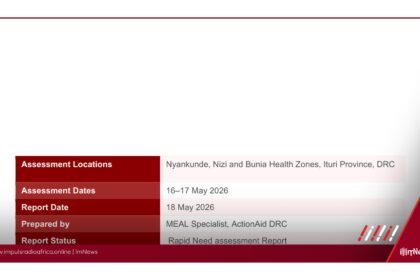
Ebola Outbreak in DRC: The Complex Challenge of Containment DATELINE: Kampala, Uganda – LEAD: The Democratic Republic of the Congo (DRC) is addressing its seventeenth Ebola outbreak, the latest in a region fraught with fragility and vulnerability.
The World Health Organization (WHO) declared the outbreak a public health emergency of international concern on May 17, 2026, its highest level of global health alert. NUT GRAF: The epicentre of the outbreak lies in informal mining communities in Ituri province, characterized by high population movement, poor sanitation, and limited formal healthcare access.
This complex scenario presents numerous challenges in containing the spread of the disease, exacerbating the existing vulnerabilities of the region.
Kampala, Uganda — The DRC has long been vulnerable to Ebola outbreaks due to its fragile healthcare systems, poverty, and ongoing conflicts.
The country’s history of Ebola outbreaks dates back to 1976, when the disease was first identified.
The recurrence of these outbreaks is often attributed to unsafe food practices, limited access to clean water, and weaknesses in the healthcare system. Congolese authorities and experts have highlighted the challenges in containing the outbreak.
The lack of a quick response by authorities and the fragility of healthcare systems are major concerns.
Aid groups and health workers have expressed concerns about the difficulty of containing the outbreak in communities already exhausted by war and facing collapsing healthcare systems.
The World Health Organization has declared the outbreak a public health emergency of international concern, indicating the severity and potential for international spread. This declaration underscores the urgency of the situation and the need for a coordinated global response.
Goma, DRC — The outbreak’s epicentre in informal mining communities in Ituri province poses unique challenges.
These areas are characterized by high population movement, which increases the risk of spreading the disease beyond the immediate area.
The poor sanitation and limited formal healthcare access further complicate efforts to contain the outbreak.
Health workers in eastern DRC are scrambling to contain the fast — moving outbreak. Contact tracing is proving to be extraordinarily difficult, as the high population movement and lack of resources hinder efforts to identify and isolate cases.
Additionally, the collapse of healthcare systems in some areas makes it challenging to provide adequate care for those affected.
Kampala, Uganda — The international community is responding to the declared public health emergency.
The Centers for Disease Control and Prevention (CDC) and the Department of Homeland Security (DHS) have announced travel restrictions and public health measures in response to the Ebola outbreak.
The World Health Organization (WHO) is scaling up support to the governments of the DRC and Uganda, strengthening surveillance, contact tracing, clinical preparedness and management, delivery of supplies, and community engagement.
London, UK — Despite the efforts of the international community, the current situation remains concerning.
The outbreak’s potential for international spread cannot be ignored, and ongoing efforts to contain the disease are crucial.
The WHO has emphasized the importance of community engagement in bringing the outbreak under control, as it is only when communities are engaged in the response that such outbreaks are brought under control.
Kampala, Uganda — The latest Ebola outbreak in the DRC serves as a stark reminder of the challenges faced by the region in combating infectious diseases.
The complex scenario of informal mining communities, high population movement, poor sanitation, and limited healthcare access presents a significant challenge in containing the spread of the disease.
The international community must continue to support the efforts of Congolese authorities and health workers in bringing the outbreak under control and preventing further spread.
KICKER: The current Ebola outbreak in the DRC highlights the need for a coordinated global response to combat infectious diseases.
As the international community works to contain the outbreak, it is crucial to address the underlying vulnerabilities in the region and strengthen healthcare systems to prevent future outbreaks.
*Additional reporting by ImNews | Sources consulted: 5*
—
This original article was produced by the ImNews editorial team
Source: Google News v2