
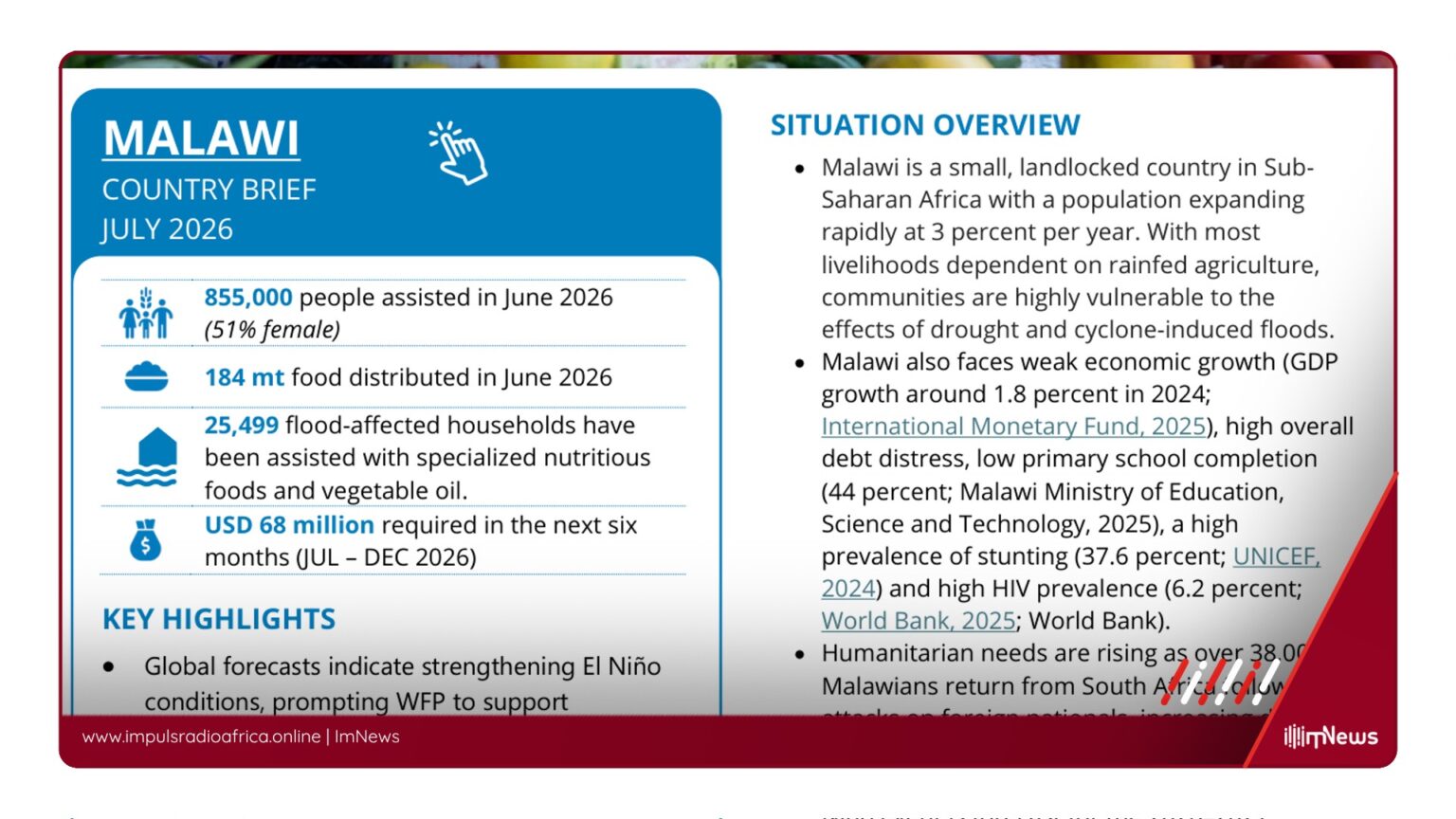
Malawi’s Food Insecurity Crisis: A Race Against Time BODY: Johannesburg, South Africa – Malawi is facing one of its most severe food insecurity crises in recent history, with over 4 million people affected in the 2025/2026 season, according to reports.
The situation has been exacerbated by El Niño conditions, which have left up to 3. 5 million people chronically food insecure and 40% of the population affected as of February 2024.
The World Food Programme (WFP) has sounded the alarm, emphasizing the urgent need for funding to combat the crisis. WFP officials have indicated that USD 13. 3 million is required to cover six-month net funding needs from March 2026 to August 2026, a figure representing 38% of their requirements.
This funding is crucial for sustaining life — saving assistance and protecting vulnerable households.
The sector’s vulnerability to external shocks, particularly climatic ones, has been highlighted by the World Bank.
The bank’s analysis underscores the country’s dependence on agriculture, which is subject to the whims of weather patterns like El Niño.
The current food insecurity crisis is not just a humanitarian issue but also has significant economic implications.
The WFP’s country brief for July 2026 notes that without additional funding, assistance for refugees and school feeding could be disrupted from September 2026, affecting over 63,000 refugees and nearly 594,000 learners.
The situation in Malawi underscores the broader challenges facing the region in terms of food security and economic resilience.
As the country grapples with the immediate needs of its population, it also faces the long — term challenge of diversifying its economy and reducing its reliance on agriculture.
The Malawian government has been working on economic and structural reforms to sustain growth, but the current crisis has highlighted the need for accelerated action.
The World Bank’s perspective on the matter focuses on the broader economic context, emphasizing the need for structural reforms to unlock prosperity.
As the situation unfolds, the international community is watching closely.
The urgency of the crisis demands a coordinated response from both local and international actors.
The WFP’s call for funding is a critical first step, but it is clear that long-term solutions are needed to address the root causes of Malawi’s food insecurity.
What happens next will be a testament to the country’s ability to respond to this crisis and its potential to build a more resilient and food-secure future.
The world is watching, and the clock is ticking.
*Additional reporting by ImNews | Sources consulted: 5*
—
This original article was produced by the ImNews editorial team
Source: reliefweb
Source: World Food Programme