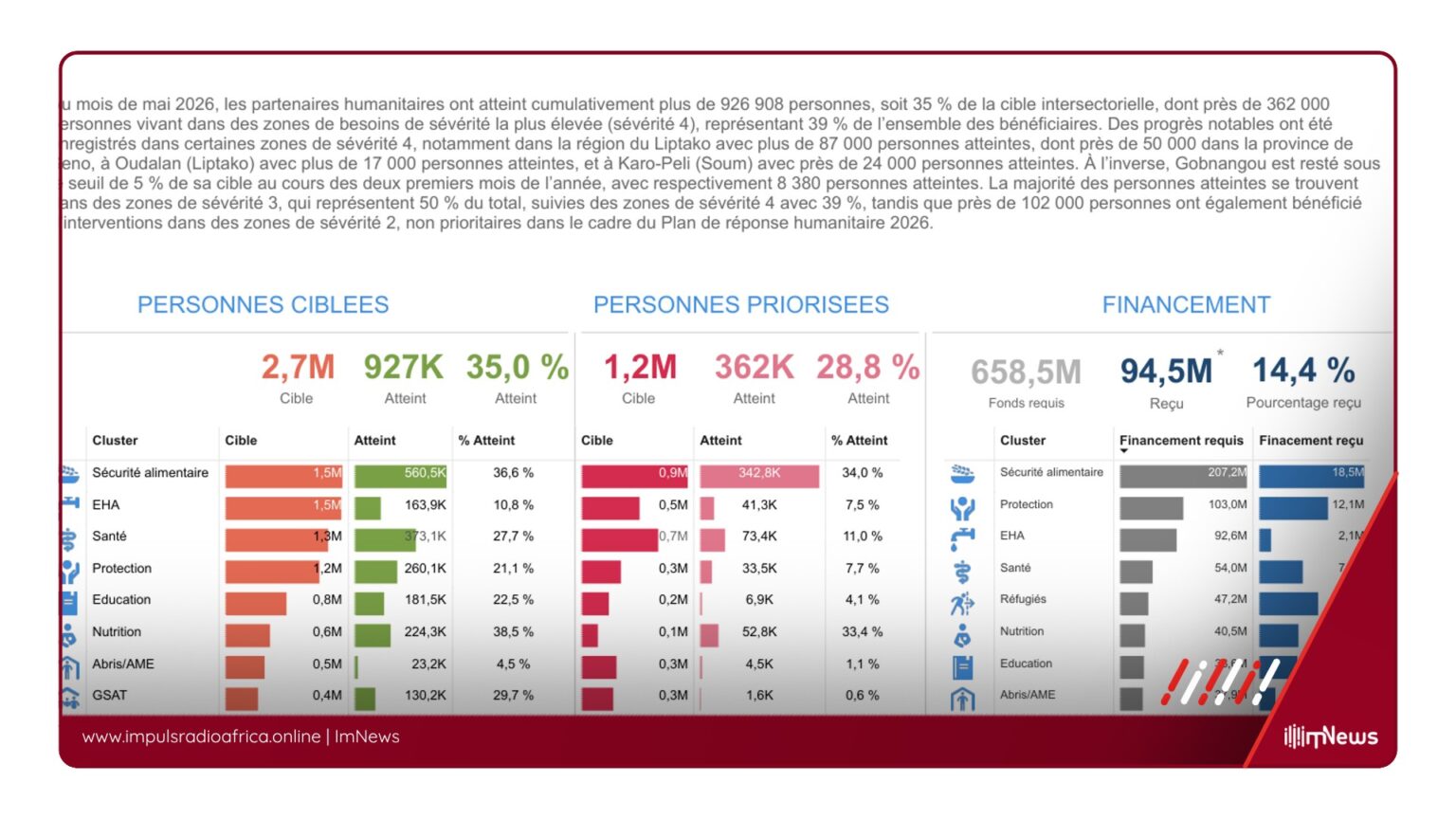
Ouagadougou, Burkina Faso — As of May 2026, humanitarian efforts in Burkina Faso have cumulatively reached over 926,908 individuals, accounting for 35% of the intersectoral target. Among these, nearly 362,000 people reside in areas of the highest need, classified as severity level 4, which represents 39% of all beneficiaries.
In the Liptako region, significant progress has been made, with over 87,000 individuals receiving assistance. This includes nearly 50,000 in the province of Seno in Oudalan and over 24,000 in the region of Karo-Peli in Soum. Conversely, Gobnangou has not met its target, reaching only 8,380 individuals by May 2026.
The crisis in Burkina Faso is complex, involving food insecurity, health emergencies, and displacement due to conflict.
In January 2026, over 276,000 people received assistance, with 203,000 for food security.
The province of Loroum in the Yaadga region has seen the highest number of beneficiaries, with over 72,000 individuals supported.
The International Organization for Migration (IOM) has outlined a humanitarian response plan that aims to leverage migration as a force for stability and opportunity.
The plan focuses on enhancing living conditions and self — reliance in crisis-affected areas, ensuring that migration contributes to resilience, inclusion, and sustainable development.
The Global Humanitarian Overview 2026 estimates that 4. 5 million people in Burkina Faso require assistance.
The plan targets 2. 7 million, including 1. 2 million considered hyper-prioritized, living in areas of high vulnerability.
While progress has been made, the situation remains critical.
The humanitarian community is working tirelessly to provide assistance, but challenges such as access constraints and limited resources continue to impede efforts.
The focus going forward will be on accelerating the response in areas with slow progress and ensuring that the most vulnerable populations receive adequate support.
The humanitarian community in Burkina Faso remains committed to addressing the multifaceted crisis and working towards a sustainable solution for the affected populations.
*Additional reporting by ImNews | Sources consulted: 5*
—
This original article was produced by the ImNews editorial team
Source: reliefweb
Source: UN Office for the Coordination of Humanitarian Affairs