Lagos, Nigeria — The Logistics & Telecommunications Sector (LTS) in Nigeria, activated in 2016 to aid in the response to protection crises, is facing significant challenges in the North-East region, according to a recent LTS Situation Report.
The area has been addressing insecurity, displacement, and a breakdown in basic services, leading to a strained response capacity.
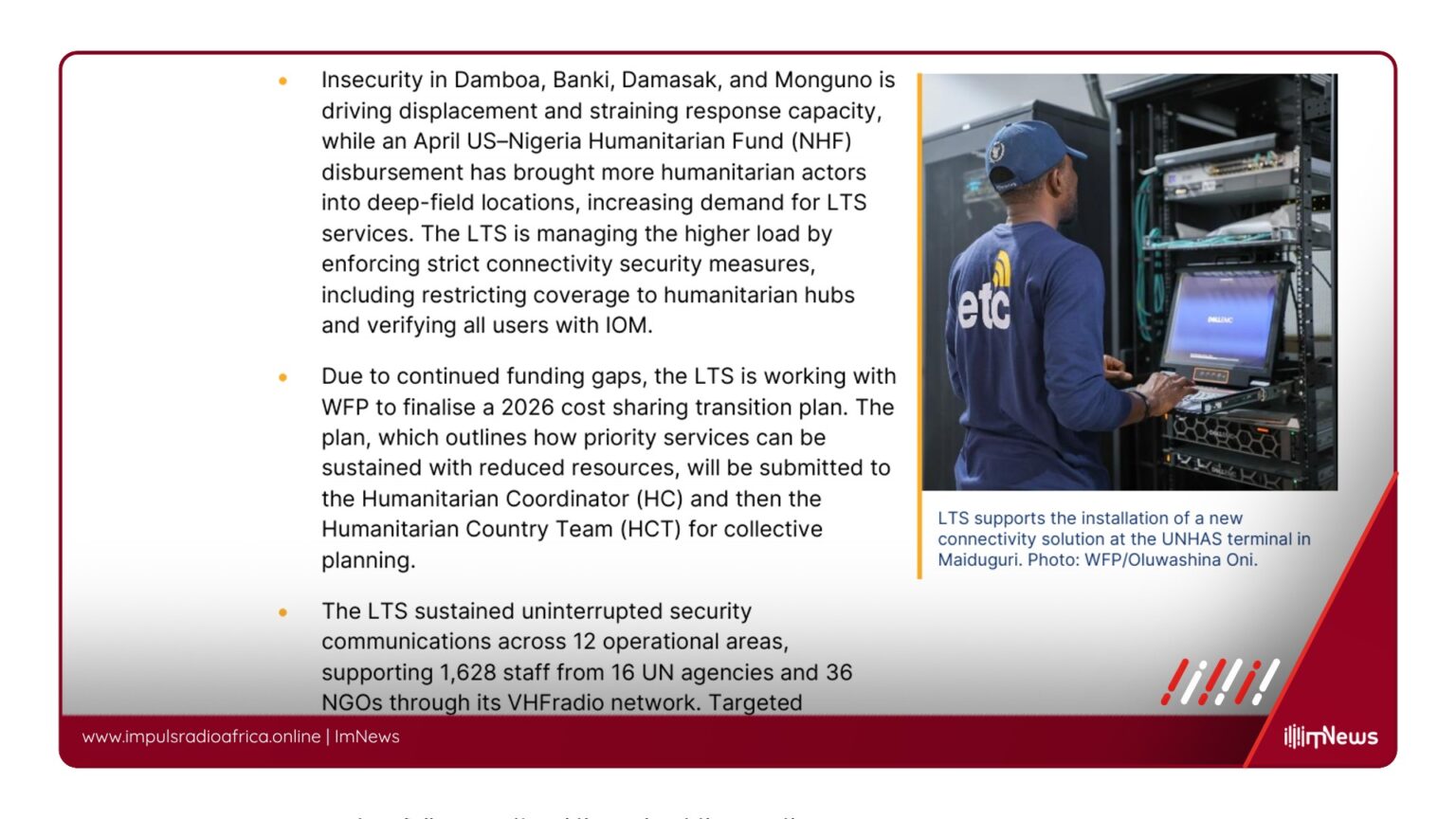
In April 2026, the LTS managed to maintain uninterrupted security communications across 12 operational areas, supporting 1,628 staff from 16 UN agencies and 36 NGOs through its VHF radio network. Despite these efforts, the LTS is under pressure due to increased demand for services and a lack of adequate funding. Insecurity in Damboa, Banki, Damasak, and Monguno has led to displacement and made it difficult for the LTS to reach those in need.
To address this, the LTS has enforced strict connectivity security measures, including limiting coverage to humanitarian hubs and verifying all users with the International Organization for Migration (IOM).
Furthermore, the LTS is working with the World Food Programme (WFP) to finalize a 2026 cost-sharing transition plan, which will outline how priority services can be sustained with reduced resources. This plan will be submitted to the Humanitarian Coordinator (HC) and the Humanitarian Country Team (HCT) for collective planning.
The LTS Situation Report also emphasizes the importance of additional research and collaboration with multiple reliable sources, such as institutional reports and verified news agencies, to ensure that the information provided is accurate, verified, and up to date.
*Additional reporting by ImNews | Sources consulted: 5*
—
This original article was produced by the ImNews editorial team
Source: reliefweb
Source: Emergency Telecommunications Cluster