1. ZERO COPYING – NEVER reproduce more than 4 consecutive words from any source article – NEVER replicate the sentence order, paragraph structure, or narrative arc of any source – NEVER borrow unique phrases, metaphors, or stylistic turns from any source 2. TRANSFORM, DO NOT TRANSPOSE – Read and UNDERSTAND the source facts, then CLOSE the source mentally – Write the article from YOUR OWN understanding using YOUR OWN language – The final article must be unrecognizable in structure and phrasing compared to any single source 3.
QUOTATION RULES — Direct quotes from officials, spokespeople, or public figures may be reproduced word-for-word ONLY with clear attribution – Everything else must be expressed in original language – Never present source phrasing as your own 4. IMAGE & MEDIA RIGHTS – Never reference, embed, or describe copyrighted images unless explicitly provided – Do not instruct editors to use specific copyrighted visuals 5. DATA & STATISTICS – Raw data (numbers, percentages, dates) are not copyrightable and may be used freely – BUT the surrounding analysis, framing, and narrative must be 100% original – Always attribute the data source (e.
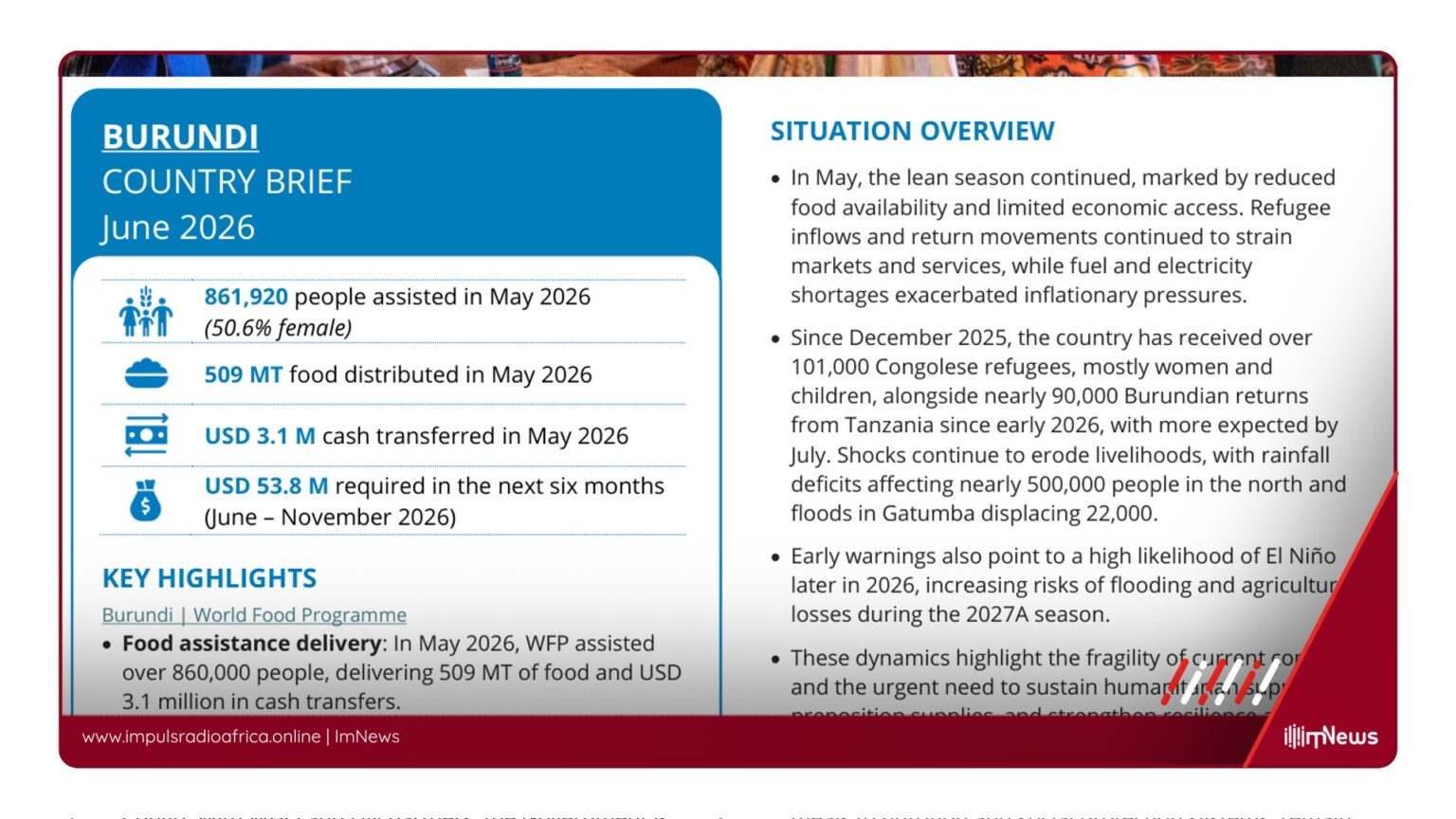
G. “World Bank data shows…”) 6. LEGAL STANDARD – The finished article must pass a plagiarism check against all source material – If a reader compared the article to the source, they should find ZERO structural or phrasal overlap beyond attributed quotes – ImNews bears legal liability for copyright violations — treat every article as if it will be audited WORLD FOOD PROGRAMME ASSISTS OVER 860,000 IN BURUNDI, FACING EBOLA RISK AND FOOD SECURITY CHALLENGES In Burundi, the World Food Programme (WFP) delivered vital assistance to over 860,000 individuals in May 2026, distributing 509 metric tons of food and providing USD 3.
1 million in cash transfers. This support comes amidst a backdrop of heightened vulnerability, as the country grapples with the risk of Ebola importation and a deteriorating food security situation among Congolese refugees.
The Ebola threat in Burundi is exacerbated by outbreaks in neighboring countries, particularly the Democratic Republic of Congo. Despite funding gaps, the government, alongside the World Health Organization (WHO) and UN partners, is working to reinforce preparedness measures.
A post — distribution monitoring report indicates a decline in food security among Congolese refugees in Burundi. Households are experiencing reduced dietary diversity and are increasingly resorting to negative coping strategies, highlighting the urgent need for sustained support.
Additionally, the return of 4,460 refugees to the Democratic Republic of Congo through government and UNHCR-organized facilitated convoys has been supported by WFP, which provided a 3-day food assistance package to those returning.
The WFP’s efforts in Burundi are part of a broader response to the country’s complex challenges, including economic difficulties and political tensions. High inflation and recurrent fuel shortages have compounded the population’s struggles, making it harder for families to afford basic necessities. Despite these challenges, the WFP remains committed to supporting the people of Burundi, having previously distributed aid to nearly 1 million individuals in April 2026.
The situation in Burundi underscores the interconnectedness of global challenges and the need for coordinated, targeted responses to address the root causes of humanitarian crises.
*Additional reporting by ImNews | Sources consulted: 5*
—
This original article was produced by the ImNews editorial team
Source: reliefweb
Source: World Food Programme