KINSHASA, Democratic Republic of the Congo — The World Food Programme (WFP) is intensifying its food assistance efforts in the eastern Democratic Republic of the Congo (DRC), where the Ebola outbreak continues to spread amidst ongoing conflicts, population displacement, and acute food insecurity. This latest epidemic surge is occurring in one of the most complex humanitarian contexts in the world.
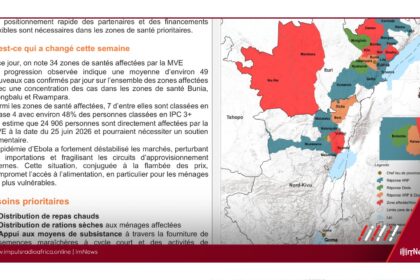
The Ebola virus is now affecting 34 health zones across Ituri, Nord-Kivu, and Sud-Kivu provinces. Among these, 30 health zones are experiencing crisis or worse levels of hunger (IPC Phase 3+), with 7 zones facing emergency food insecurity (IPC Phase 4). Over 10 million people in the eastern DRC are in a state of food insecurity, severely limiting their ability to cope with a new shock.
The WFP is providing assistance to over 1. 2 million people through food aid, nutritional support, and logistical, telecommunication, and air transport services that support the health response. Since May 28, more than 36,000 meals have been served to over 1,600 patients, companions, and contacts in 14 treatment and isolation centers.
Rations have been provided to over 2,600 people in Nord-Kivu and Ituri, and monthly food assistance is reaching 14,000 people living in ten quarantined villages in Sud-Kivu.
The WFP is also supporting nutritional activities in seven affected health zones.
However, challenges in nutritional screening and weak triage mechanisms are limiting targeted interventions.
The WFP is responsible for the logistics of the Ebola response, enabling rapid and safe movement of health and humanitarian partners to affected communities.
The UN Humanitarian Air Service (UNHAS), managed by the WFP, has conducted 268 flights, transported over 1,750 humanitarian workers, and delivered 36 tons of essential cargo to the front lines.
The WFP and its partners are expanding access to newly affected areas, including Butembo, Bambu, Kilo, Nizi, Tchomia, and Kasenyi, where populations are already facing acute food insecurity and mass displacements. Persistent insecurity and access constraints remain major obstacles, with several affected health zones located near active front lines.
The WFP urgently needs $72 million over the next six months to maintain its food assistance operations, UNHAS services, and logistical support for the Ebola response.
The national WFP requires $286 million over the next six months to continue its essential food assistance operations in the DRC.
The WFP remains deeply concerned about the plight of the most vulnerable populations.
*Additional reporting by ImNews | Sources consulted: 5*
—
This original article was produced by the ImNews editorial team
Source: reliefweb
Source: World Food Programme