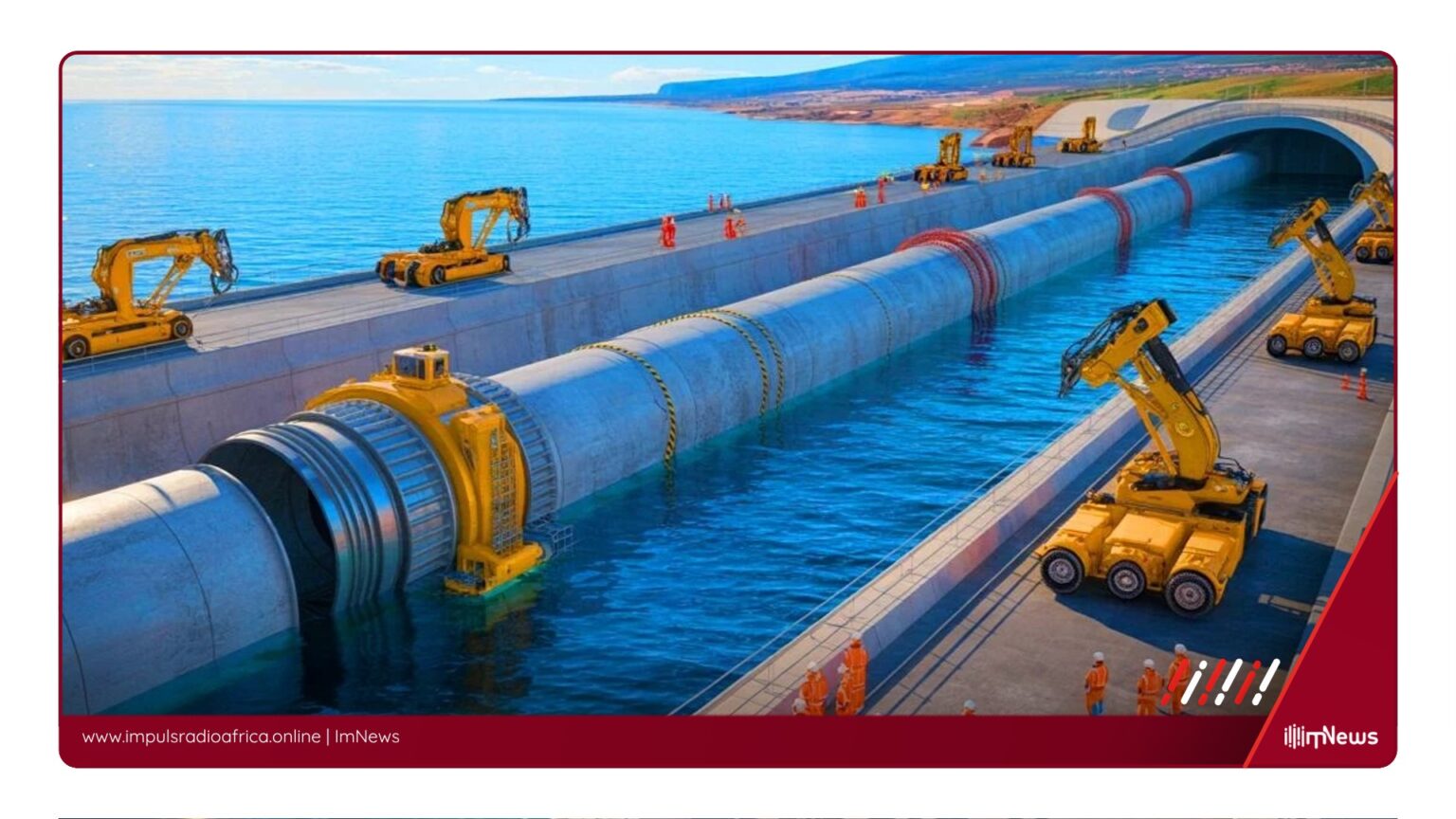
In a landmark development, Spain and Morocco have advanced their plans to construct a groundbreaking submarine tunnel beneath the Strait of Gibraltar. The two nations have formalized their intentions through a memorandum of understanding (MoU), signed between Spain’s National Geographic Institute and Morocco’s National Center for Scientific and Technical Research (CNRST). The agreement is set to pave the way for joint research into the seismicity and geodynamics of the strait, a crucial step before proceeding with the ambitious project.
The initiative, which has been in the pipeline for nearly half a century, was formalized on December 4, 2025, when Spanish Transport Minister Óscar Puente and Moroccan counterpart Karim Zidane met at La Moncloa. The Spanish government has already allocated €1.73 million to fund technical studies, as reported by Spanish outlet OKDiario. These studies are being carried out by SECEGSA, a public company established in the 1980s with the express purpose of advancing the tunnel’s construction.
The proposed tunnel would span approximately 65 kilometers in total, with around 40 kilometers situated under Spanish territory. The northern entrance is planned near Vejer de la Frontera, and the distance between terminal stations is 42 kilometers, including 38. 5 kilometers of actual tunnel length.
The submarine section would extend for 27. 7 kilometers, reaching a depth of 475 meters at its deepest point.
The infrastructure would feature two independent single — track railway tubes, each with a circular cross-section of 7.90 meters in interior diameter. A central service gallery of 6 meters in diameter would facilitate emergencies and maintenance, while cross-passages connecting the tubes would be spaced every 340 meters. SECEGSA has also commissioned a feasibility study from Herrenknecht Ibérica, which confirmed the project’s technical viability within current engineering limits, although it cautioned about the substantial logistical and economic challenges ahead.
The subsurface beneath the Umbral de Camarinal, the underwater ridge separating the Mediterranean Sea from the Atlantic Ocean, is characterized by complex geological layers, which pose significant challenges for the tunneling process. The estimated cost for the Spanish side alone exceeds €8.5 billion, with the tunnel expected to be completed between 2035 and 2040. The memorandum outlines a three-year study on seismic activity, potential earthquakes and tsunamis, and the geodynamic behavior of the strait.
Before any construction can commence, the excavation of a reconnaissance gallery could be approved, with the initial tender potentially taking place in 2027. This phase is expected to take between six and nine years to complete. A marine research campaign is scheduled for the first half of 2026, involving Spain’s Superior Council of Scientific Research (CSIC) and other international bodies. The campaign aims to gather comprehensive data on the geological and environmental conditions of the strait.
The strait’s ecological significance adds an additional layer of complexity to the project. Over 100,000 vessels transit the strait annually, and the research area is within a Special Conservation Zone, home to over 1,900 marine flora and fauna species. Strict environmental permits and oversight will be required for the project to proceed.
Source: moroccoworldnews
Original author: Adil Faouzi