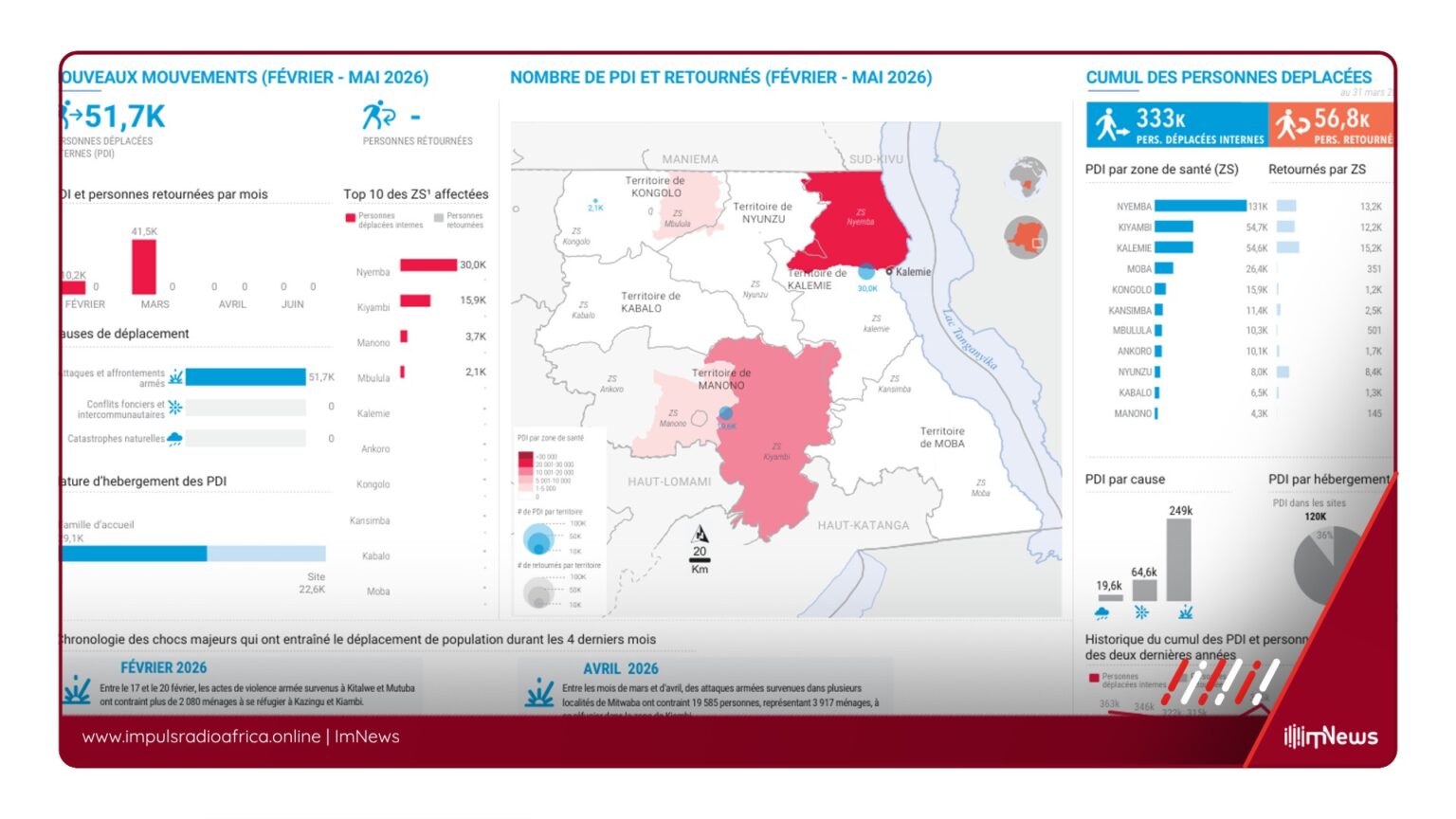
Over 51,000 Displaced in Tanganyika, DRC Amidst Escalating Conflict BODY: Kinshasa, DRC – Between February and May 2026, the province of Tanganyika in the Democratic Republic of the Congo (DRC) has witnessed a surge in internal displacements, with over 51,000 new displacements recorded, according to the UN Office for the Coordination of Humanitarian Affairs. This increase in displacement is entirely due to armed attacks and confrontations, highlighting the province’s volatile security situation.
As of March 31, 2026, Tanganyika had more than 333,000 internally displaced persons (IDPs), with 36% of them living in sites.
The situation is particularly dire in areas such as Nyemba, Kiyambi, and Manono, where the majority of the displacements have occurred.
In January 2026 alone, over 41,000 new displacements were recorded, pushing the total number of displaced individuals to 333,000. Of these displacements, 76% were attributed to armed conflict, while 19% were due to land and intercommunity conflicts.
Despite the ongoing conflict, there has been some positive movement as over 56,800 people have returned to their villages of origin over the past 18 months.
This return is primarily in health zones such as Kalemie, Kiambi, Nyemba, and Nyunzu, indicating a gradual recovery in certain areas.
The DRC has a history of instability and intermittent conflict, particularly in the Tanganyika province.
Since the early 1990s, the country has faced systemic corruption, economic decline, and conflict that have disrupted social order and livelihoods. This has contributed to a situation where the DRC’s economy remains underperforming, exacerbating the humanitarian crisis in Tanganyika.
The UN Office for the Coordination of Humanitarian Affairs has provided detailed information on the displacement and humanitarian situation in Tanganyika, emphasizing the causes of the displacements and the scale of the crisis.
According to their reports, the humanitarian community in the DRC is facing a critical funding gap, which is forcing them to strictly prioritize their response in 2026.
The economic website ‘economy. Com’discusses the broader economic challenges faced by the DRC, which have been exacerbated by instability and conflict.
These challenges potentially contribute to the displacement crisis in Tanganyika, as the economic downturn affects the livelihoods of the local population, leading to increased tensions and conflict.
The situation in Tanganyika is a testament to the broader humanitarian crisis in the DRC, marked by ongoing armed conflicts, massive displacement, climate shocks, and recurrent epidemics.
The UN has launched an urgent appeal for US$1.
4 billion to address humanitarian needs in the DRC, but the critical funding gap poses significant challenges to the overall humanitarian response.
The escalating conflict in Tanganyika underscores the need for a comprehensive and coordinated approach to address the root causes of the crisis. This includes efforts to promote peace, stability, and economic development in the region.
Only through such a multi — faceted approach can the humanitarian crisis in Tanganyika be effectively addressed, ensuring the safety and well-being of the affected population.
*Additional reporting by ImNews | Sources consulted: 5*
—
This original article was produced by the ImNews editorial team
Source: reliefweb
Source: UN Office for the Coordination of Humanitarian Affairs