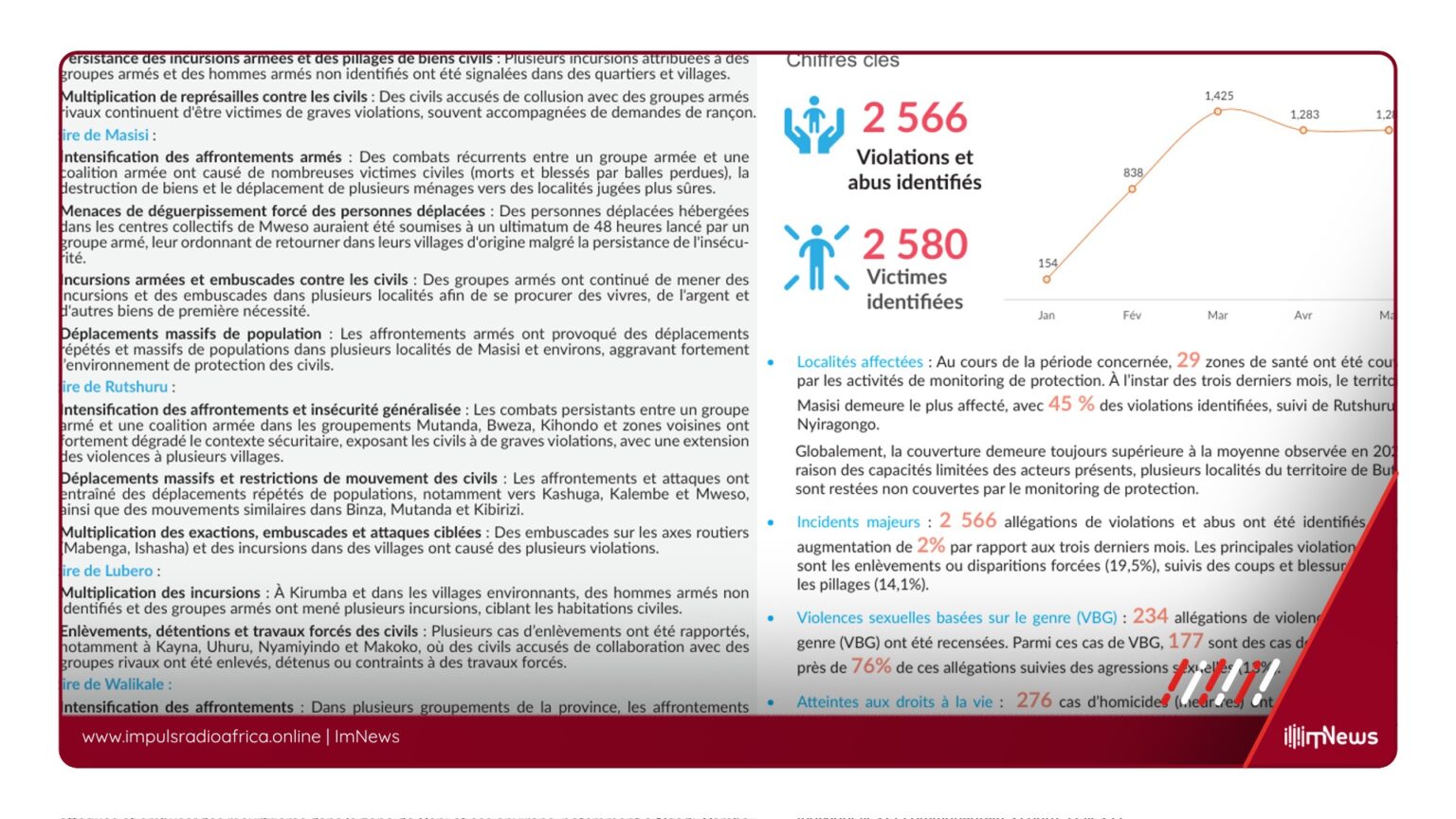
Kinshasa, DRC — The Democratic Republic of the Congo’s Nord-Kivu province is witnessing a marked deterioration in the protection situation, characterized by the persistence and multiplication of armed confrontations in various territories. Between April and May 2026, the Protection Cluster reported a significant escalation in armed confrontations, particularly in Masisi, Rutshuru, Lubero, Walikale, and the areas of Nyiragongo and Beni.
The situation on the ground is further complicated by serious violations against civilians, including armed incursions, looting, ambushes, abductions, forced labor, and targeted reprisals. Civilian populations are increasingly exposed to violence linked to accusations of collaboration or the territorial and economic control strategies of armed groups. Forcible displacements have become recurrent and often cyclic, reflecting the lack of sustainable protection solutions and the constant pressure on displaced communities.
The Protection Cluster, in collaboration with humanitarian partners, has been closely monitoring the protection situation in Nord — Kivu.
The cluster’s reports indicate that the primary protection risks concern attacks on life and physical integrity, as well as severe movement restrictions due to insecurity along key routes.
The mass and repeated displacements are also exacerbating the vulnerability of the affected populations.
The Ebola epidemic, which has expanded into Nord — Kivu, adds another layer of complexity to the humanitarian crisis.
A laboratory — confirmed case was reported in Kinshasa, the capital, on May 16, among someone returning from Ituri, according to the World Health Organization.
The presence of Ebola in an area already addressing violence and displacement poses a significant risk of further exacerbating the humanitarian situation.
The economic impact of the crisis is profound.
The DRC’s economy, already beleaguered by systemic corruption and intermittent conflict, has been further weakened by ongoing instability.
According to Economy. Com, the country’s economic performance has been poor, with reduced national output and government revenue, and increased external debt.
The international community must respond with urgency and resources to address both the immediate humanitarian needs and the long — term challenges posed by the ongoing conflict and the Ebola epidemic.
As the situation evolves, the need for a coordinated and comprehensive response from the international community becomes increasingly apparent.
The challenges in Nord — Kivu are not just a regional concern but have global implications, particularly as the Ebola outbreak threatens to spread beyond the affected areas.
*Additional reporting by ImNews | Sources consulted: 5*
—
This original article was produced by the ImNews editorial team
Source: reliefweb
Source: Protection Cluster