Abidjan, Ivory Coast — The humanitarian situation in Ivory Coast has been significantly exacerbated by the ongoing crisis in the Sahel region, with thousands of refugees seeking refuge in the country’s northern regions.
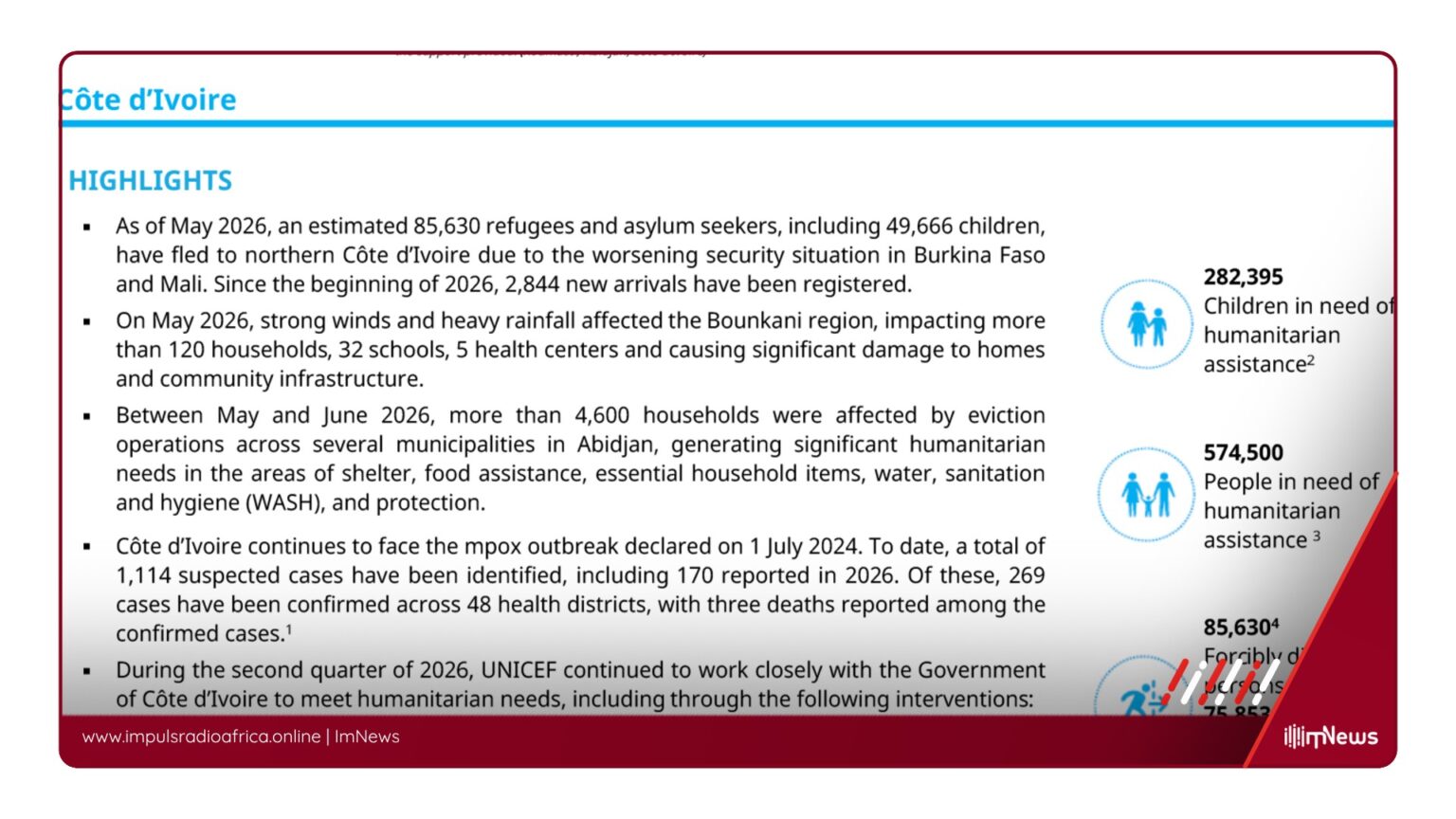
As of May 2026, an estimated 85,630 refugees and asylum seekers, including 49,666 children, have fled to northern Côte d’Ivoire due to the security situation in Burkina Faso and Mali.
The influx of refugees has put immense pressure on the Ivorian government and its resources, as the country grapples with the dual challenges of hosting those displaced from neighboring countries and addressing the internal needs of its own population.
In May 2026, strong winds and heavy rainfall affected the Bounkani region, impacting more than 120 households, 32 schools, and 5 health centers, causing significant damage to homes and community infrastructure.
Additionally, between May and June 2026, more than 4,600 households were affected by eviction operations across several municipalities in Abidjan, generating significant humanitarian needs in the areas of shelter, food assistance, essential household items, water, sanitation, and hygiene (WASH), and protection. Côte d’Ivoire continues to face the mpox outbreak declared on 1 July 2024. To date, a total of 1,114 suspected cases have been identified, including 170 reported in 2026.
Of these, 269 cases have been confirmed across 48 health districts, with three deaths reported among the confirmed cases.
In response to these challenges, UNICEF has been actively involved in addressing the humanitarian needs, including interventions such as screening 1,608 children under five for wasting and treating 352 severely malnourished children.
The organization has also vaccinated 23,810 children against measles in the two main regions hosting refugees and asylum seekers, and provided safe water and hygiene and kitchen sets to 16,000 people, including 7,865 children. UNICEF has also supported the delivery of alternative early childhood education through the Preschool on Wednesdays and Saturdays (PréMS) programme, reaching 763 children, including 441 girls.
As the situation in the Sahel region continues to worsen, the humanitarian situation in Ivory Coast is likely to remain critical.
The international community must act swiftly to provide the necessary resources and support to alleviate the suffering of those affected and to prevent further escalation of the crisis.
*Additional reporting by ImNews | Sources consulted: 5*
—
This original article was produced by the ImNews editorial team
Source: reliefweb
Source: UN Children's Fund