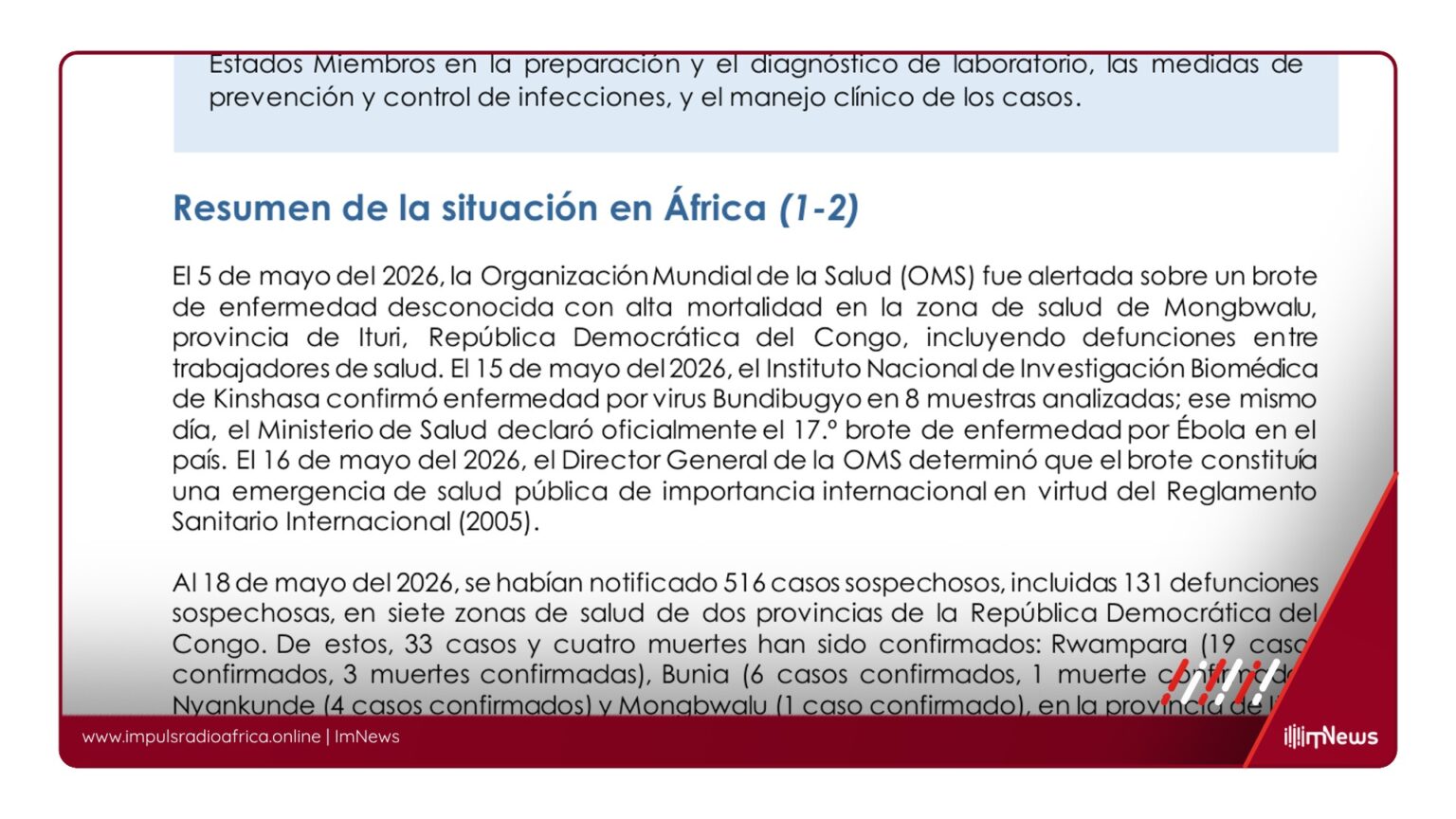
Kampala, Uganda — Ebola Outbreak Declared Public Health Emergency in DRC and Uganda Kampala, Uganda – The World Health Organization (WHO) has declared the ongoing Ebola outbreak in the Democratic Republic of the Congo (DRC) and Uganda a Public Health Emergency of International Concern (PHEIC), marking the first time the Bundibugyo virus, a filovirus related to Ebola, has caused such an emergency.
The declaration comes as the 17th Ebola outbreak in the DRC since the virus was first identified in 1976 intensifies, with the virus now spreading across the border into Uganda.
As of 16 May 2026, there were eight laboratory-confirmed cases, 246 suspected cases, and 80 suspected deaths reported in the Ituri Province of the DRC and Uganda.
The PHEIC status underscores the seriousness of the situation, necessitating international coordination and cooperation to contain the outbreak.
The presence of large refugee communities and the high mobility of populations, including cross — border trade flows, pose significant challenges to the control efforts. Unlike other Ebola viruses, there are no licensed vaccines or specific treatments for Bundibugyo virus disease, emphasizing the reliance on public health measures such as case management, infection prevention and control, and community engagement.
The lack of a vaccine or specific treatments means that response strategies are primarily focused on preventing the spread of the virus. This includes rigorous infection prevention and control measures, such as contact tracing and the isolation of infected individuals. Community engagement is also crucial, as understanding and cooperation from local populations are vital for the success of these measures.
Despite the challenges, there are signs of progress.
The WHO, along with other international health organizations, has deployed response teams to the affected health zones in the DRC and Uganda. Research and development initiatives are also being mobilized to identify and advance potential medical countermeasures against the Bundibugyo virus.
However, there remain unanswered questions regarding the effectiveness of current public health measures in controlling the spread of the virus.
Additionally, the impact of the presence of large refugee communities on the response efforts is yet to be fully assessed.
The declaration of a PHEIC by the WHO highlights the need for a comprehensive and coordinated international response to the Ebola outbreak.
It also serves as a stark reminder of the global health risks posed by emerging infectious diseases, particularly in regions with weak health systems and high levels of population mobility.
As the situation unfolds, the world watches closely to see how the combined efforts of local, national, and international health agencies can bring this Ebola outbreak under control, preventing further spread and loss of life. ### Kicker The international community awaits updates on the progress of the response efforts and the development of potential medical countermeasures against the Bundibugyo virus, hoping to prevent the further escalation of this public health emergency.
*Additional reporting by ImNews | Sources consulted: 5*
—
This original article was produced by the ImNews editorial team
Source: reliefweb
Source: Pan American Health Organization