
Lagos, Nigeria — The United Nations High Commissioner for Refugees (UNHCR) has released its latest monthly statistics for coastal countries, including Ghana, revealing a concerning rise in the number of refugees and internally displaced persons (IDPs) within the nation’s borders. Ghana’s coastal location along the Gulf of Guinea has made it a point of concern for the UNHCR, particularly given the significant cross-border displacement in the region, especially from the Sahel.
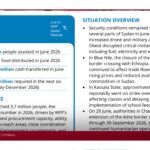
The infographic published by the UNHCR in June 2026 not only detailed the monthly statistics but also highlighted key issues such as Protection and Human Rights, as well as Water Sanitation Hygiene (WASH) in Ghana.
The UNHCR’s publications on the matter emphasize the rights and protection of refugees and IDPs, underlining the need for international support and collaboration. This comes as the government of Ghana and various stakeholders, including the private sector, are working towards new economic pathways for refugees and host communities in northern Ghana.
On April 9, 2026, over 50 participants, including 30 private sector companies and investment partners, along with government and development stakeholders, convened at the GRASP Public–Private Sector Dialogue 2026 in Accra.
The event, organized by the UNHCR operation in Ghana, aimed to advance investment in the livelihoods of refugees and host communities through the Ghana Refugee Agribusiness and Sustainability Programme (GRASP). This joint initiative connects refugee inclusion with national development priorities and positions agribusiness as a pathway to economic opportunity, self-reliance, and resilience.
The dialogue highlighted the need to move beyond short — term assistance toward approaches that enable people to work, earn, and contribute to local economies.
With over 30,000 asylum seekers arriving in Ghana since 2022, primarily in rural northern regions, the event underscored the importance of sustainable solutions for the management of refugee and IDP populations.
The UNHCR’s Rights Mapping and Analysis Platform further illustrates the complex situation in Ghana, with a mixed population of registered and unregistered refugees and asylum-seekers predominantly originating from Burkina Faso and Togo.
As of April 2025, the platform indicated that there were 18,351 refugees and 549 asylum-seekers in Ghana, with a total country population of 35,064,273.
Despite the challenges, the UNHCR’s recent high-level meeting on International Migration Review Forum 2026 in Ghana has led to the development of a three-year National Implementation Plan. This plan aims to prioritize the protection of migrants’human rights, structured management of return and reintegration, and the exercise of national sovereignty.
The monthly statistics dashboard for Ghana, released by the UNHCR on July 23, 2026, provides a comprehensive overview of the situation, including data on refugees, asylum seekers, and IDPs.
The dashboard also offers insights into the various sectors that require attention, such as protection, education, registration, and information management.
As the situation in Ghana continues to evolve, it is crucial for the international community to remain engaged and support the nation in its efforts to address the challenges faced by refugees and IDPs.
The UNHCR’s commitment to protecting the rights and well-being of these individuals remains a key factor in the ongoing efforts to provide a safe and dignified life for all those affected by displacement.
*Additional reporting by ImNews | Sources consulted: 5*
—
This original article was produced by the ImNews editorial team
Source: reliefweb
Source: UN High Commissioner for Refugees